The table and the deck
Four players, two teams. Your partner sits opposite you; the two opponents sit at your sides. The deck has 56 cards:
- 52 regular cards, 2 to Ace, in four suits: star, sword, pagoda and jade. They rank 2 < 3 < … < 10 < Jack < Queen < King < Ace. The suits have no ranking among themselves — only the value matters, except for straight-flush bombs.
-
4 special cards: the
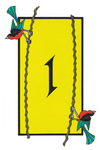 Mah Jong (value 1, the lowest), the
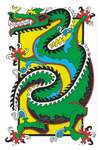 Dragon (the highest), the
 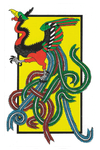 Phoenix (a wild card) and the
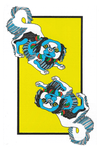 Dog. Each is explained on the
Special cards page.
Dog. Each is explained on the
Special cards page.
The goal of a round is to get rid of all your cards before the others. The goal of the game is for your team to reach 1000 points first.
Dealing, Grand Tichu and Tichu
The deal comes in two parts, and you make your first decision in between.
- You receive 8 cards. Look at them. If you believe you will finish first with these, call Grand Tichu: if you do finish first, your team gets 200 points; if not, it loses 200.
- You receive the remaining 6. With 14 cards in hand you may call a plain Tichu, worth 100 points — on the same condition: you must finish first. You can call Tichu at any moment until you play your first card of the round, even if you have already passed.
Each player calls for themselves, but the points go to the team. You cannot call both, and more than one player may call in the same round — in which case at most one of them wins the bet.
With your 8 cards you see the "Grand Tichu" and "Deal" buttons. "Deal" brings the other 6. The "Tichu" button stays active until your first play.
Passing cards
Once everyone has 14 cards, each player passes one card, face down, to each of the other three: one to their partner and one to each opponent. Everyone passes at the same time, then picks up the three cards they received. What you pass is one of the most important decisions of the round — see passing strategy.
The player holding the Mah Jong starts the round.
Combinations
Whoever has the lead plays a combination. The next player must play a combination of the same kind, with the same number of cards, and higher — or pass. The only exception is bombs.
| Combination | What it is | Example |
|---|---|---|
| Single | One card. The highest single is the Dragon, then the Ace. | 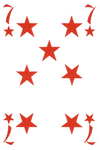 |
| Pair | Two cards of the same value. | 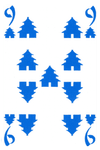  |
| Run of pairs | Two or more pairs of consecutive values. Can only be beaten by a run with the same number of pairs. | 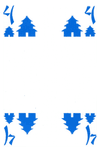 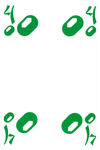 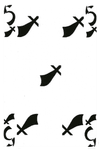 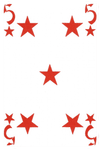 |
| Triple | Three cards of the same value. | 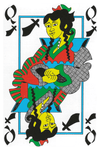 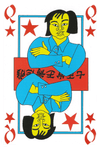 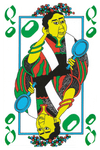 |
| Full house | A triple and a pair together. Compared by the value of the triple. | 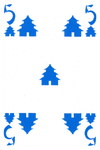 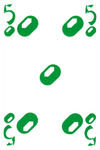  |
| Straight | At least five consecutive cards, in any suits. Can only be beaten by a straight of the same length with a higher top card. The Mah Jong counts as 1. | 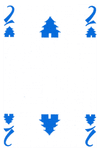 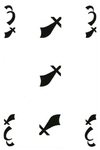 |
The Phoenix can take the place of any missing card in any combination — but never in a bomb. Played alone, it is worth half a point more than the card it covers. Details under special cards.
Bombs
Two combinations are bombs and break the basic rule: they beat anything else, regardless of kind and number of cards, and they can be played even when it is not your turn.
| Bomb | What it is | Example |
|---|---|---|
| Four of a kind | Four cards of the same value. | 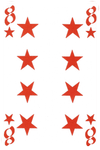 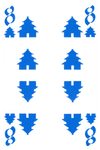 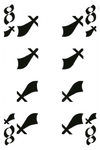 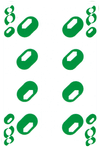 |
| Straight flush | At least five consecutive cards in the same suit. | 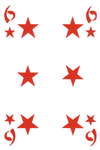 |
A bomb can only be beaten by a bigger bomb. The order:
- Between two fours of a kind, the higher wins.
- Any straight flush beats any four of a kind.
- Between two straight flushes, the longer wins; at equal length, the one with the higher top card.
The Phoenix never takes part in a bomb. The Dragon can only be beaten by a bomb.
A bomb is played with the "Bomb" button, which only appears when you hold one. You cannot bomb before the player with the Mah Jong has opened the round.
Passing, tricks and the lead
You are never obliged to play — you can pass even if you hold something that would beat the table. And passing does not lock you out: if the trick comes back around to you, you may play.
A trick closes when, after a play, the other three players all pass. Whoever played last takes the trick — the cards and their points — and opens the next one with any combination they like.
Two special cases:
- If the trick was won with the Dragon, the winner does not keep it: they give it to one of the two opponents, whichever they choose.
- If you open with the Dog, there is no trick: the lead passes immediately to your partner.
The only obligation in the game comes from the Mah Jong: if the player who played it wished for a value, the first player who can legally play that value must do so.
End of a round and the 1-2
The round ends when the third player goes out — one player is left holding cards. That last player:
- gives the cards still in their hand to the opposing team,
- gives the tricks they had collected to the player who finished first.
Then you count: fives 5, tens and kings 10, Dragon +25, Phoenix −25, always 100 in total for both teams together. Any Tichu and Grand Tichu calls are added on top.
There is also a shorter ending, the 1-2: if both players of the same team finish first and second, the round stops there. The team scores 200 points, the other team nothing, and the cards are not counted at all. Tichu calls still count.
The game ends in the round in which a team reaches or passes 1000 points. All the worked examples with numbers are on the Scoring page.
The plays on video, from the dod.gr table
Fifteen short clips, one for each play, as it looks on the dod.gr screen.
Frequently asked questions about the rules
Can I pass when I hold a card that would beat the table?
Yes. Passing is always your choice, however good the card you hold. The only obligation is a value wished for with the Mah Jong.
If I pass, am I out of the trick?
No. If someone plays after you and the turn comes back around, you may play normally. The trick only closes when all three players pass after the last play.
How many cards must a straight have?
At least five. There is no upper limit — a straight from the Mah Jong to the Ace has 14 cards. It can only be beaten by a straight with exactly the same number of cards.
Can I play a bomb when it is not my turn?
Yes, at any moment during a trick, even if you passed earlier. The bomb interrupts the turn order and play continues from you. dod.gr adds one restriction: not before the player with the Mah Jong has opened.
Who starts the next round?
Always whoever receives the Mah Jong in the new deal, not the winner of the previous round.
Do the last player's tricks count?
Yes, but not for them: they go to the player who finished first. The cards left in their hand go to the opposing team.
The best lesson is one round
On dod.gr the game only shows you the legal plays — you cannot break a rule, only make a bad choice.