
The Dragon
The highest card in the game. It is played only as a single — it never joins a pair, a straight or any other combination — and it beats every single, even a Phoenix sitting on an Ace. The only thing that beats it is a bomb.
It is worth +25 points, more than any other card. But it comes with a condition: if you win a trick with the Dragon, you do not keep it. You give the whole trick — Dragon, points and whatever else it holds — to one of the two opponents, whichever you choose. That is why the Dragon is usually played when the trick is poor in points, or when taking the lead is worth more than the 25.
If someone kills the Dragon with a bomb, they take the trick — and the 25 points with it. It is one of the most expensive reversals in the game.
As soon as you win a trick with the Dragon, two buttons appear, one for each opponent. You pick who receives it and play continues from you.
The mistake: playing the Dragon early on a low single, just to take the lead. You give away 25 points and lose your answer to the opponent's Ace.

The Phoenix
The wild card of Tichu, with two faces.
Inside a combination it stands in for any missing card: it turns a pair into a triple, a triple into a full house, fills a straight from the middle or the ends. The one prohibition: never in a bomb. No four of a kind and no straight flush with a Phoenix.
As a single it is worth half a point more than the card it covers: on a 10 it is a 10½, on an Ace it is an Ace-and-a-half — and then only the Dragon or a bomb can beat it. It cannot be played on the Dragon. If you open a trick with the Phoenix alone, it counts as 1½.
In points it is worth −25: whichever team has it in its tricks at the end of the round loses 25. That is the price of its flexibility. Often the smartest way to use it is to drop it into a trick the opponent is going to take anyway.
When the Phoenix could go at either end of a straight, the game asks you which value you want it to take. The same happens whenever its position is ambiguous.
The mistake: passing the Phoenix to an opponent "to get rid of the −25". You are handing them the most flexible resource in the game. Points can be recovered; the wild card cannot.

The Mah Jong
The "1" of Tichu, the lowest card. It has three roles.
- It opens the round. Whoever holds it after the passing opens the first trick — with any combination they like, not necessarily the Mah Jong itself.
- It plays as a 1. On its own it beats nothing, so it can only be played to open a trick. It does, however, fit at the bottom of a straight: 1-2-3-4-5.
- It demands a card. The moment you play it — alone or inside a straight — you may wish for a value from 2 to Ace. From then on, the first player who can legally play that value (that is, in a combination that beats the table) is obliged to do so, even if it means breaking up a bomb. The wish stays active until it is fulfilled.
In points it is worth 0.
As soon as you play the Mah Jong, the "Request card" bar appears with the values 2 to A. You pick one or close it without a wish. While a wish is pending, the game remembers it for you and enforces the rule on the others.
The mistake: wishing for a value your partner holds. You force them to play a card they may have wanted to keep. Before wishing, think about who is most likely to hold it — see Mah Jong strategy.

The Dog
The simplest card and the most misunderstood. The Dog beats nothing and is beaten by nothing: it can be played only when you have the lead and the table is empty, and all it does is hand the lead to your partner. Immediately. Nobody can interfere — not even with a bomb.
If your partner has already gone out, the lead passes to the next player after them. So before you play the Dog, check who is still in the round.
In points it is worth 0.
The Dog is your partner's card: the ideal way to give them the opening when they have called Tichu or are close to going out. It is also one card fewer for you, without having to beat anyone.
The mistake: keeping it for last. If your final card is the Dog and you do not have the lead, you cannot go out — you are waiting to win a trick with… nothing. Get rid of it the first time you open a trick and have nothing better to do with the lead.
Summary
| Card | As a single | Points | The special thing |
|---|---|---|---|
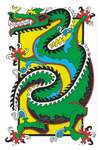 Dragon Dragon |
The highest | +25 | Its trick goes to an opponent. Beaten only by a bomb. |
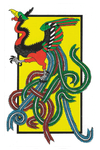 Phoenix Phoenix |
½ above whatever is on the table | −25 | Wild in every combination except bombs. Not on the Dragon. |
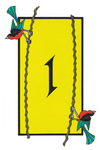 Mah Jong Mah Jong |
1, the lowest | 0 | Opens the round. Wishes for a value the others must play. |
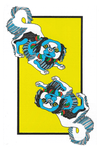 Dog Dog |
— | 0 | Only as an opening. The lead goes to your partner. |
Frequently asked questions about the special cards
Does the Phoenix beat the Ace?
Yes. On an Ace the Phoenix counts as an Ace-and-a-half. After that only the Dragon or a bomb can continue the trick.
Can I play the Phoenix on the Dragon?
No. The Dragon can only be beaten by a bomb. The Phoenix's "half above" does not apply to the Dragon.
Which opponent do I give the Dragon's trick to?
Whichever of the two you like. Usually the one furthest from going out, or the one who has collected fewer points. You cannot give it to your partner.
Can I wish for an Ace with the Mah Jong?
Yes, any value from 2 to Ace. You cannot wish for a special card. The Ace is one of the most common wishes, because it forces an opponent to play it early.
Can the Phoenix stand in for the Mah Jong in a straight?
No. The Phoenix takes values from 2 to Ace. The 1 of a straight can only be the Mah Jong itself.
What if I play the Dog and my partner has already gone out?
The lead passes to the next player after your partner — that is, an opponent. This is why the Dog needs care towards the end of a round.
See the four cards at the table
On dod.gr you play with exactly this deck. The game shows you when each special card can be played.